On the wall of our consultation room, above the herbal cabinet, hangs a small black and white photograph. It shows my great-grandfather, Liu Bao-ching, standing in a doorway in Quanzhou, Fujian Province, probably in 1939 or 1940. He is wearing a dark tunic and holding a small wooden case in his left hand. The case held his acupuncture needles. He was, by the standards of the village, a modestly successful country physician. Within five years he and his wife would be on a boat to Manila with two children, one of whom was my grandfather, and the small wooden case would be one of the few possessions that made the crossing.
This is the family story. I tell it here not because it is extraordinary — in Binondo it is an almost generic story, shared with hundreds of other families — but because I am asked about it often enough by new patients that it seems worth writing down. If you have read the broader history of acupuncture in the Philippines I wrote separately, consider this the same history told at a specific kitchen table.
The first generation: Quanzhou to Binondo, 1946
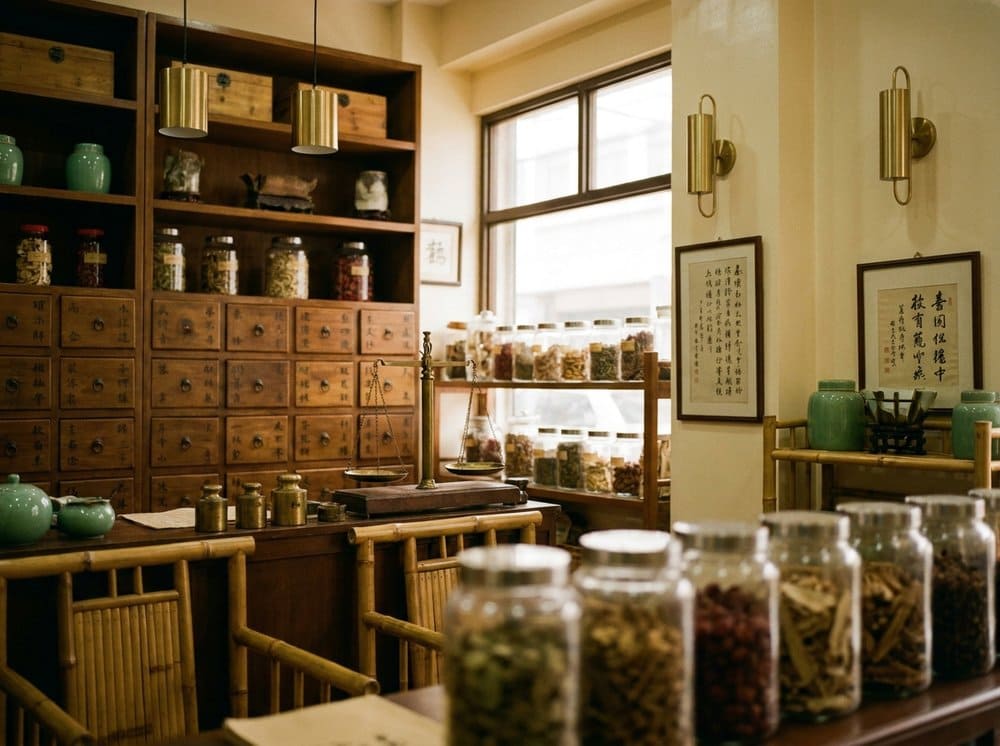
My great-grandparents arrived in Manila in late 1946, after the war had ended and the boats started running again. They joined a cousin who had been in Binondo since the 1920s and who owned a modest apothecary on a side street off Ongpin. The cousin needed a physician who could do needling; my great-grandfather needed somewhere to start. For the next twelve years he saw patients in the back room of that apothecary, mostly Chinese labourers and shopkeepers who paid in small amounts of cash or, in several documented cases, in kind — rice, pork shoulder, a basket of mangoes.
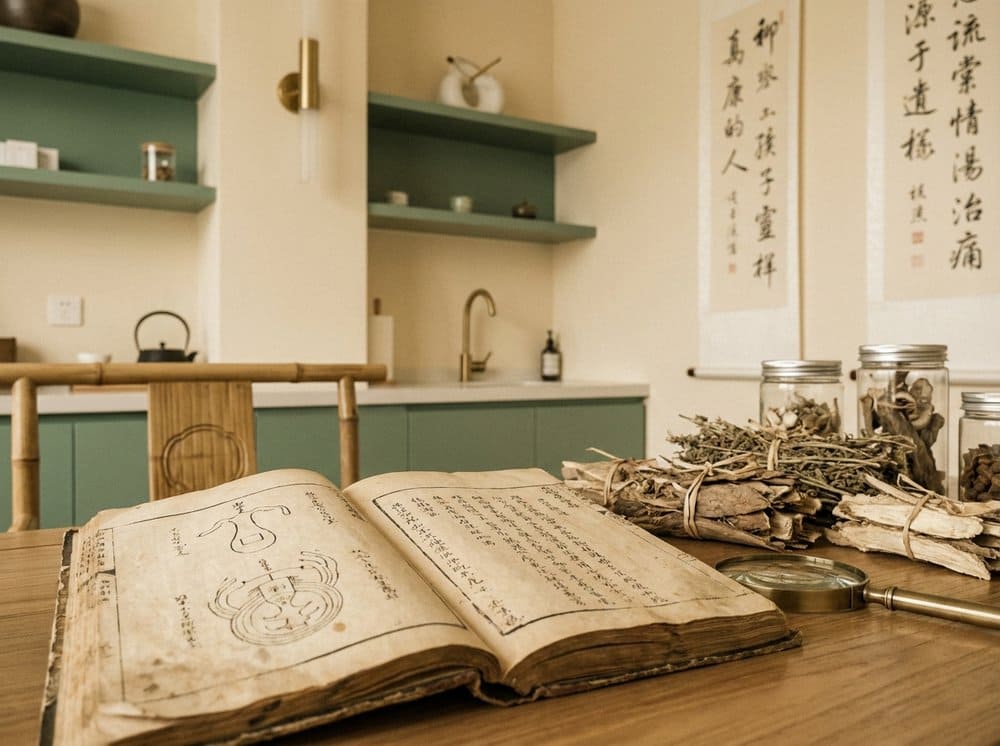
He kept a notebook. I have it. The entries are in a formal brushed Hokkien, and the diagnoses are written in the classical shorthand that my family still uses for internal pattern identification. The notebook has a particular line that my grandfather later quoted to me as a clinical rule: "The patient tells you in the first five minutes. The rest of the consultation is confirmation." I have found this to be more accurate than I would like.
The second generation: my grandfather, trained in the back room
My grandfather, Liu Tian-sheng, learned the trade the old way — as his father's apprentice from the age of fourteen, with no formal schooling in medicine. He took over the Binondo practice in 1961 when his father's eyesight failed, and he ran it through the difficult decades of the 1960s and 1970s. These were not easy years to practise. The Chinese apothecary trade was legal but precarious; the mainstream Philippine medical establishment largely ignored it; and the Marcos era brought a particular brand of bureaucratic indifference that made any kind of professional registration impossible.
My grandfather kept the practice alive partly through stubborn discipline and partly through the unusual decision — unusual for his generation — to teach his daughters as seriously as he would have taught sons. My mother and my aunt both learned the pulse at his side from childhood. My mother, the younger of the two, eventually chose clinical nursing and worked at Chinese General Hospital for thirty-two years. My aunt took over the Binondo practice in 1994 and still runs it today, at seventy-eight, with no signs of slowing.
The third generation: me, and a decision about training
I grew up in San Juan, played in the Binondo back room during weekends, and was comfortable with pulse-taking before I was comfortable with long division. The question in our family was never whether I would practise — it was where I would be trained. My grandfather, who was still alive through my late teens, was adamant that modern TCM required modern training. He had read enough of the mid-1980s literature coming out of Beijing and Shanghai to know that the field was moving, and he did not want his granddaughter to practise in 1995 with a 1955 toolkit.
I chose Nanjing University of Chinese Medicine for the Bachelor's programme — five years beginning in 2000. Nanjing was then, and remains, one of the two or three most rigorous TCM faculties in Greater China. I spent the first two years in anatomy, Western pharmacology, classical Chinese, and pulse theory, in roughly that order. The next three were clinical rotations in the university hospital. I did my internship in the rheumatology-equivalent ward — which is when I realised that joint pain was going to be my clinical centre. The long Nanjing winters, ironically, gave me my first sustained exposure to cold-invasion patterns I had rarely seen in tropical Manila.
My grandfather used to say that a physician has to walk in at least two climates before she can recognise her own. In Nanjing I learned what a truly cold joint looks like. When I came home I understood Manila's damp-heat Bi-syndrome in a way that I could not have understood before.
The Taipei fellowship, and the long way home
After Nanjing I spent two years on a clinical fellowship at China Medical University Hospital in Taichung and then at a private integrative clinic in Taipei. Taiwan runs its TCM differently from the mainland — more conservative with formula selection, more integrated with the national health insurance system, and more focused on chronic-pain and geriatric work. I learned the institutional discipline in Nanjing; I learned the patient-centred slow pace in Taiwan. I also met my husband in Taipei, which is a different story.
I came back to Manila in 2009 and spent two years practising alongside my aunt in Binondo. In 2011 I opened the Legazpi Village practice that is now Synergy Meridian Clinic. The decision to move from Binondo to Makati was not about abandoning the ancestral neighbourhood — I still see patients there on Saturday mornings — but about meeting a younger, HMO-insured, professional population that needed TCM delivered in a slightly different register. The clinical work is identical. The waiting room is more air-conditioned.
The fourth generation, tentatively
My daughter is fifteen. She has been coming to the clinic on school holidays since she could walk. She can take a pulse, not yet well but not badly. Whether she will choose this work is entirely her decision. What is no longer in question is whether the option will be available to her — that answer was settled by three previous generations who, between them, carried the needle from Quanzhou to Binondo to Makati without dropping it.
Why the story matters clinically
Patients sometimes ask whether this family history changes anything about the treatment they receive. Honestly, only in one way: it changes how long I am willing to wait for a chronic pattern to shift. I grew up watching my grandfather take six months to fully resolve a case that a modern clinician would declare intractable after six weeks. That patience is the clearest thing I inherited. It shows up in the way I write herbal prescriptions, in the way I pace acupuncture courses, and in my kitchen-apothecary recommendations — which are almost always calibrated for slow effect rather than fast relief. It also quietly shapes how we think about chronic pain work in the clinic, something I've written about in the notes on living with chronic pain in Manila.
The wooden case my great-grandfather carried from Fujian still sits in our family cabinet in San Juan. The needles inside it are ornamental now. The practice he started is not.