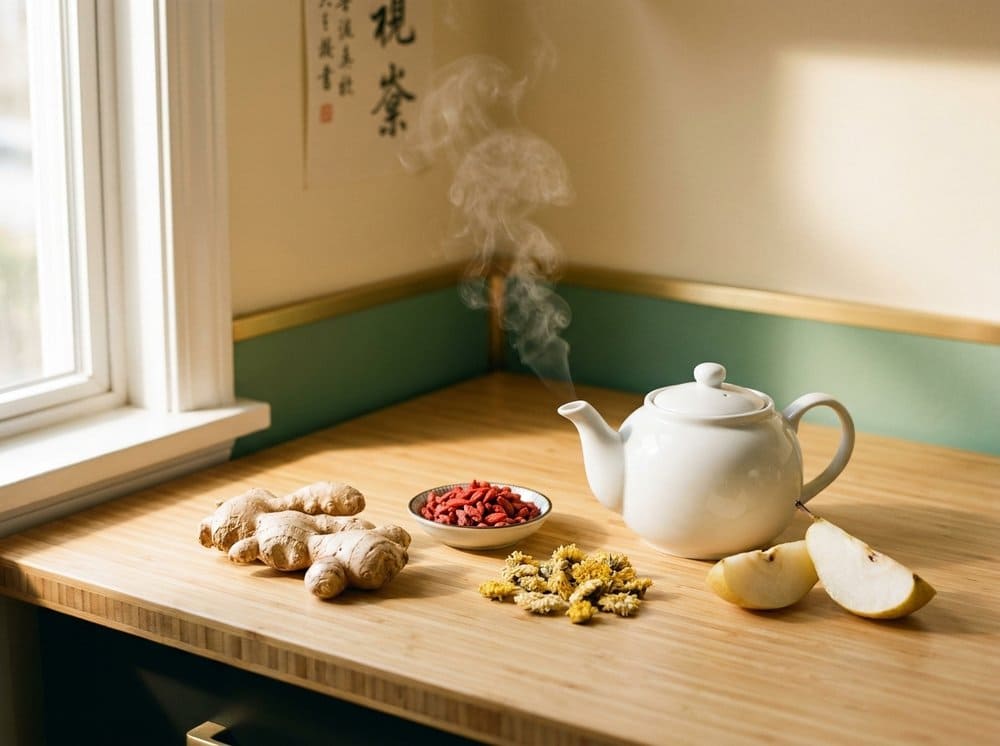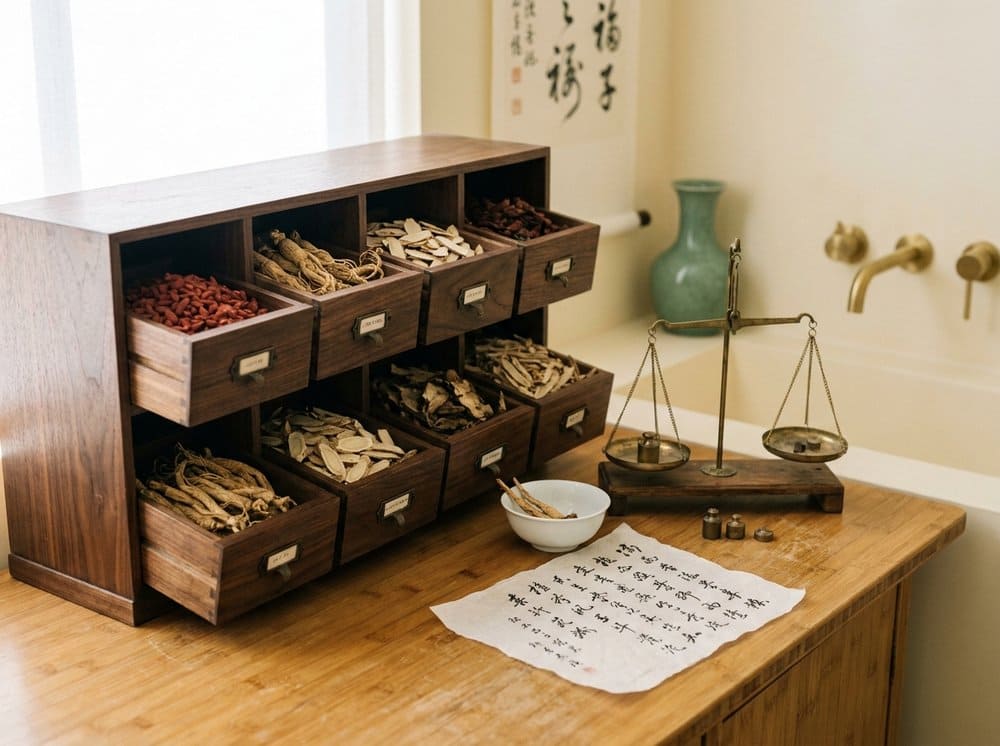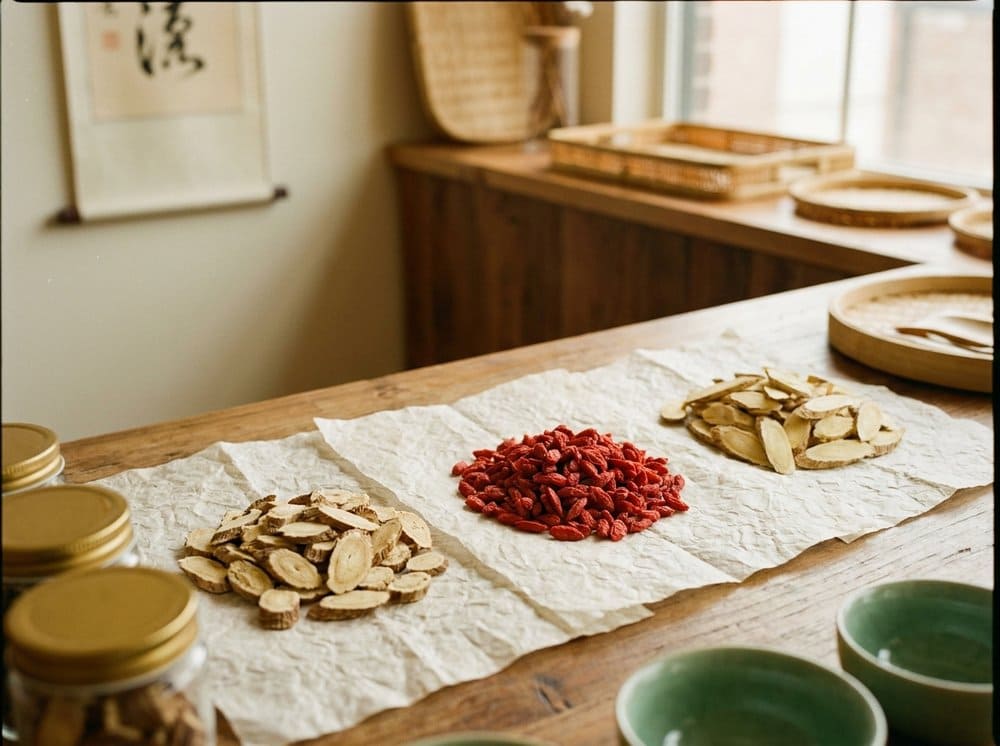
The shelves of a working Chinese-Filipino kitchen in Binondo or San Juan almost always contain the same quiet pantry: dried red berries in a glass jar, a paper bag of pale sliced roots, a lump of fresh ginger near the cutting board, and — in more careful homes — a smaller bag of what a grandmother might call "the tough yellow slices." That last one is huang qi, astragalus. The others are goji, gou qi zi, and the ginger that Filipino kitchens already know as luya.
None of these are exotic. None require a trip to a specialist apothecary. All four can be found, in good quality, in the shops along Ongpin Street or at any supermarket with a decent Asian aisle. Used thoughtfully, they make up a slow kitchen medicine that TCM has been deploying for two thousand years. Used carelessly, they cause problems. This article is about both.
Gou qi zi — the red berry
Goji berries (Lycium barbarum) are sweet, slightly sour, and energetically neutral-to-warm. Classical texts place them in the Liver and Kidney channels, with functions described as nourishing Yin, benefiting the eyes, and calming the mind. In modern language: they are rich in zeaxanthin, anthocyanins, and polysaccharides with documented antioxidant effects.
For joint patients I most often recommend them in the Chinese-Filipino kitchen congee I've written about separately — a small handful soaked for ten minutes and stirred into the last two minutes of cooking. Over-boiling makes them mushy and degrades the polysaccharides. Cold-steeping in a glass of hot water for fifteen minutes also works, and the water-plus-berries can be drunk together.
Typical dose: one tablespoon (roughly 10–15g) dried berries per day is a gentle household amount. In a formal herbal prescription we may use more or less depending on pattern.
When to use: dry eyes, tired vision, low-grade Kidney-Liver Yin deficiency patterns, mild night sweats, the slightly wiry-and-thin pulse picture of middle-aged desk workers.
When not to use: during active digestive upset (diarrhoea, loose stools), high fever, or during damp-heat flares when the tongue is thick and yellow. Goji in a damp stomach is like throwing fruit into wet laundry.
Huang qi — astragalus root
Astragalus (Astragalus membranaceus) is the workhorse of the TCM tonic pharmacy. It is sweet, mildly warming, and enters the Lung and Spleen channels. Functions: tonifies Qi, raises Yang, stabilises the exterior (i.e., helps the body resist superficial pathogenic invasion). In modern research it shows significant immunomodulatory activity and is the herb most studied in Chinese post-surgical recovery literature.
For patients with chronic joint pain that worsens with fatigue — the classic presentation of a Spleen Qi deficiency with damp accumulation — huang qi is the slow background support that lets acupuncture and manual therapy do their work more efficiently. It is not a quick-acting herb. You feel it after two or three weeks of daily use, not after one cup.
In the kitchen: simmer four or five dried slices in 500ml of water for thirty minutes, then use that broth as the base for chicken tinola (the soup Filipino grandmothers already make with ginger and malunggay, which is almost a Chinese-Filipino translation of a classical Qi-tonifying broth). Remove the slices before serving — they are too fibrous to eat directly.
Typical dose: 10–15g dried sliced root per day in a household preparation.
Safety note — huang qi has measurable anticoagulant activity. Patients on warfarin, rivaroxaban, or apixaban should not self-prescribe it. Discuss with your physician first. This is not a theoretical caution. I have seen INR shifts in patients who added daily astragalus broth to their warfarin routine without telling anyone.
Luya / sheng jiang — fresh ginger
Ginger needs no introduction in a Filipino kitchen. In TCM it is considered acrid, warming, and entering the Lung, Spleen, and Stomach channels. Its functions: warms the middle, disperses cold, resolves damp, and — in ways Western pharmacology now endorses — reduces nausea and inflammation via multiple bioactive compounds (gingerols, shogaols, zingerone).
For cold-damp Bi-syndrome knees — the presentation we often see in patients chronically over-exposed to office air-conditioning — a daily fresh ginger tea in the morning is genuinely therapeutic. Slice three or four coins of fresh ginger, steep in just-off-the-boil water for eight minutes, drink warm. For heavier cases, add brown sugar or palm sugar.
When not to use: red-edged tongue, dry mouth, night sweats, hot flushes — these are Yin-deficiency heat signs, and ginger in this constitution makes things worse.
Luo han guo / luya mixtures — the sweeter pantry
Many Filipino households already combine ginger with calamansi, honey, or palm sugar. This is, almost accidentally, a textbook TCM preparation. Small additions — a half teaspoon of dried luo han guo (monk fruit), a stick of cinnamon bark, a single star anise — convert a breakfast drink into something a physician would happily approve. None of these overpower each other if used at household doses.
A warning about self-prescription
The Chinese kitchen apothecary is safe as long as you stay inside household-dose territory and honest about what you are actually taking. The problems I see in clinic fall into three categories:
- Drug-herb interactions. Astragalus with anticoagulants. Ginger and ginseng with blood-pressure medications (both can potentiate or blunt effect depending on timing). Licorice root (gan cao) with corticosteroids. If you are on chronic medication, bring the bottle to your herbal consultation so we can build a kitchen plan that doesn't fight your prescriptions.
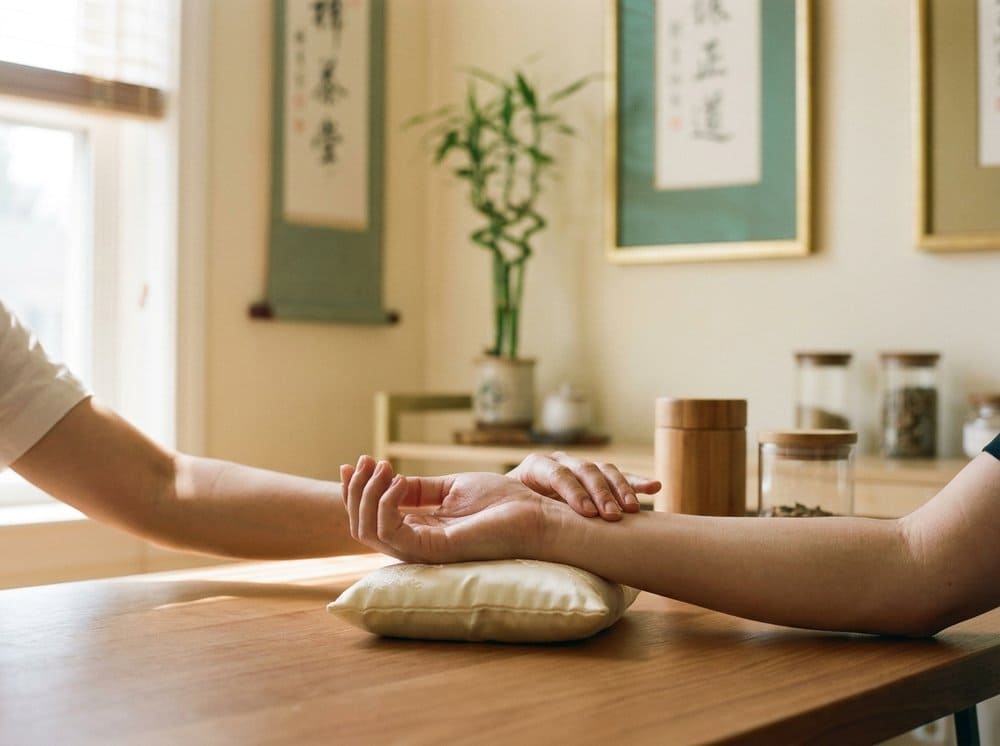
- Wrong pattern, right herb. A good herb in a wrong-pattern body makes the pattern worse. This is why pulse and tongue diagnosis matters — see my colleague's patient-facing guide to what your physician is reading.
- Quality and storage. Goji berries should smell sweet, not sour-fermented. Astragalus slices should be pale yellow, not dark brown. Ginger should be firm, not fibrous. Store everything in airtight containers away from Manila's humidity — a folded paper towel in the jar helps absorb moisture.
The larger point
The kitchen apothecary is not a substitute for clinical care. It is the infrastructure that clinical care sits on top of. In our family, as in many Filipino-Chinese families, it has been doing that quietly for four generations.