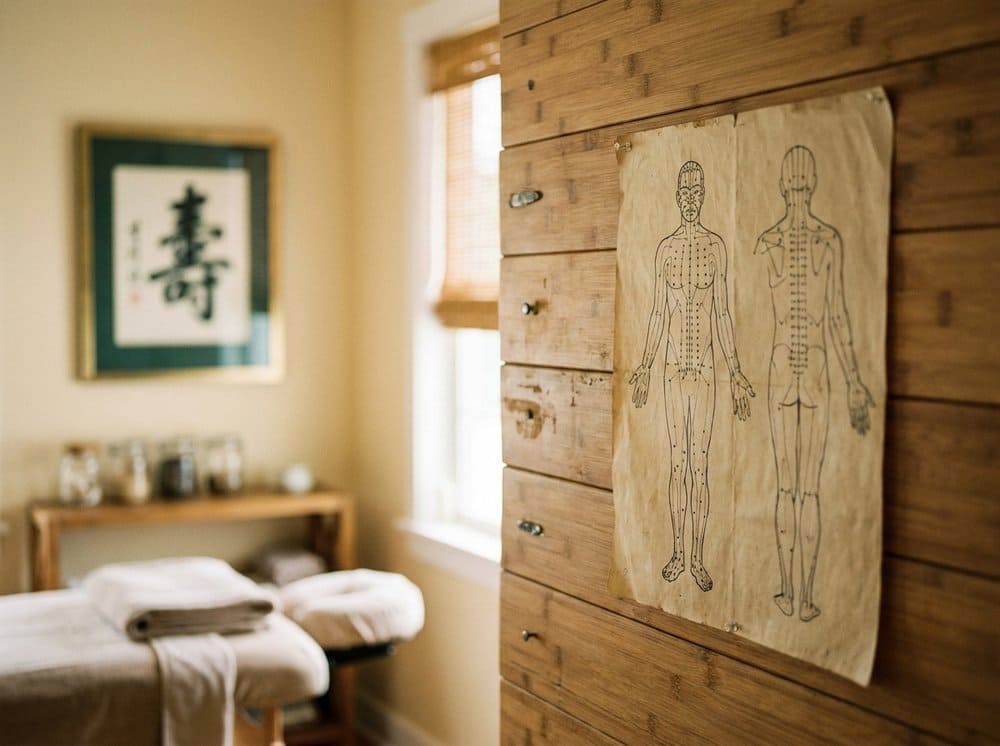
Every new patient at our clinic goes through the same small ritual at the start of the first visit. The physician takes the patient's right wrist, rests three fingers on the radial artery just below the thumb, closes her eyes for about twenty seconds, and then does the same on the left wrist. Then she asks the patient to stick out the tongue. No blood draw, no imaging, no questions for a moment. Just touch and sight.
Patients often ask me afterwards, quietly, what on earth just happened. This article is my attempt to answer that question properly, before you sit in the consultation chair, so that the minute spent at your wrist feels like information rather than theatre.
What the pulse actually is
The pulse is the heartbeat delivered through a peripheral artery, but in TCM we read it in a more layered way than a Western cardiologist does. The radial artery at the wrist is divided into three positions — cun, guan, chi — under the index, middle, and ring fingers respectively. Each position corresponds to a set of internal organ systems. Each position is read at three depths: superficial, middle, and deep. Six positions times three depths on two wrists is thirty-six data points. A trained physician samples most of them in about twenty seconds.
From that sampling we form a pulse picture described by a classical vocabulary. The same vocabulary has been in clinical use since Wang Shuhe wrote his Mai Jing (Pulse Classic) in the late 3rd century. Twenty-eight canonical pulse qualities exist. In practice, for joint and chronic-pain work in Makati, six come up constantly.
The six pulses you will probably hear named
Slippery (滑, hua)
Feels like pearls rolling under the finger — rounded, smooth, unusually easy to catch. In a joint-pain context it strongly suggests damp accumulation. In Manila's humidity this is by far the most common pulse finding. It is also the pulse of pregnancy, which is why physicians always ask women of reproductive age a careful question before naming it.
Wiry (弦, xian)
Feels like a taut guitar string under the finger — long, straight, tense. Classically associated with the Liver system and with pain, stagnation, and emotional tension. A patient with chronic shoulder tightness from desk work and unresolved stress will often present wiry on the left guan position.
Floating (浮, fu)
Easy to feel with light pressure, fading when you press in. Classically an invasion at the surface — wind, early-stage pattern, something the body is trying to push outward. In a joint-pain context it often signals that the pattern is still mobile and has not yet settled into a deep, chronic form.
Deep (沉, chen)
The opposite — you must press hard to catch it. Suggests a pattern that has moved inward and become structural. Chronic low back pain from a long-seated office job frequently reads deep.
Thin / Thready (細, xi)
A narrow pulse, like a thread. Often indicates deficiency of Blood or Yin. Common in older patients with dry skin, night sweats, and the degenerative joint presentations that Kidney-channel work addresses.
Choppy (澀, se)
Irregular, uneven, as though the flow hesitates. Suggests Blood stagnation. A patient recovering from an old sports injury or post-surgical joint may present choppy over the corresponding position.
What the tongue actually shows
The tongue is, quite literally, a mirror of the interior that the physician can see. Its body (the muscular tissue) reflects the state of the deeper substances — Qi, Blood, Yin, Yang. Its coating (the fur-like layer on top) reflects the state of the middle system — digestion, dampness, heat.
Four readings matter most in a Makati joint-pain consultation:
Red versus pale body
A red tongue body, especially at the tip or edges, suggests heat — often stress-heat or an inflammatory joint presentation. A pale body suggests deficiency of Blood or Yang. The normal tongue is a quiet, even pink.
Thick greasy coating
A heavy white or yellow coating that you could almost scrape off suggests damp accumulation. In our climate this finding is almost universal among patients who present in the pre-rainy-season weeks. It is the tongue-side confirmation of the slippery pulse described above.
Cracks and fissures
Deep central cracks suggest long-standing Stomach Yin deficiency. Short transverse cracks at the sides often show up in patients with chronic digestive patterns that feed the joint presentation. This is where the herbal kitchen becomes clinically important — you cannot un-crack a tongue with needling alone.
Swollen, scalloped edges
The tongue looks too big for the mouth and shows tooth marks along the edges. A classic sign of Spleen Qi deficiency with damp. Extremely common in women over forty in a humid climate, and a frequent finding in patients whose knee swelling worsens after meals.
How this feeds the meridian reading
Pulse and tongue are not ends in themselves. They point the physician toward a pattern, and the pattern tells her which channels to work on. If you have read our earlier piece on how meridians map to joint pain, you now have the two halves of the same clinical act: the reading (pulse + tongue) tells us what; the channel map tells us where.
For a chronic knee patient, a slippery pulse at the right guan with a thick yellow coating and a swollen tongue sends us toward Stomach and Spleen channel work with a damp-clearing herbal pairing. For a wiry left guan with a red-edged tongue and no coating change, we go to the Liver-Gall Bladder territory with a softening and moving strategy instead. Same patient, same knee, two different treatments — the pulse and the tongue are what distinguishes them.
Wang Shuhe wrote that the pulse is the language by which the inner body speaks to the physician. Thirteen centuries later, in a Makati clinic, it still is. The rest of the consultation is translation.
What to expect on your first visit
We will not ask you to do anything unusual. Please avoid brushing your tongue that morning (many people scrape off exactly the coating we want to see). Avoid coffee for at least two hours — caffeine changes the pulse quality. Bring a list of any medications and supplements you are taking. The reading takes two minutes. The conversation afterwards, and the treatment plan that follows, takes the rest of the visit. This diagnostic minute, however, is where the work begins.