The word meridian has had a difficult century. For much of the 20th century Western medicine treated it with polite dismissal — a metaphorical plumbing system that Chinese physicians had invented because they lacked anatomy. For much of the early 21st century Western wellness culture went the opposite way, invoking meridians as mystical energy highways that do not quite correspond to anything a scalpel can find. Both positions are wrong in a useful way. The truth sits quietly between them, and it is where clinical acupuncture actually lives.
What the classical model says
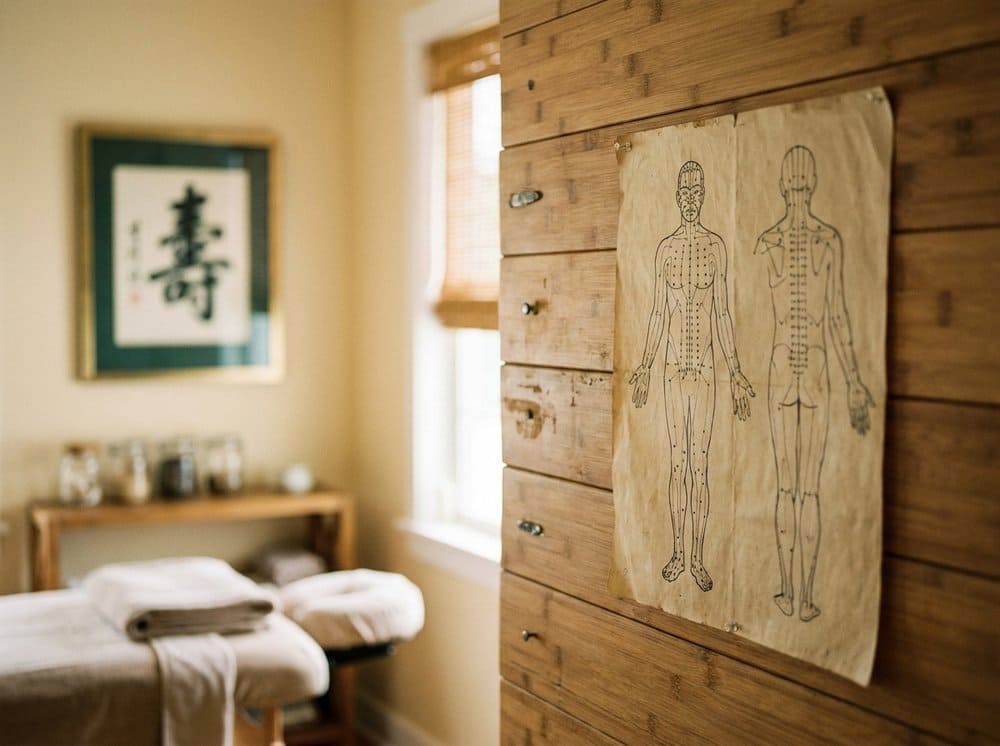
The Huangdi Neijing, compiled roughly 2,300 years ago, describes twelve zheng jing — regular channels — that run bilaterally on the body. Six are yang channels traversing the outer aspects of the limbs and back; six are yin channels along the inner aspects of the limbs and torso. Each channel is named for the organ it is functionally paired with: Lung, Large Intestine, Stomach, Spleen, Heart, Small Intestine, Bladder, Kidney, Pericardium, San Jiao, Gall Bladder, Liver. Over each channel sits a constellation of points — 361 classical acupoints in total — where needling or pressure produces a measurable physiological response.
To this, classical theory adds eight qi jing ba mai, the extraordinary vessels. The two most clinically important are Ren (Conception) running up the anterior midline and Du (Governing) running up the posterior midline. The remaining six act as reservoirs that regulate flow between the regular channels. For chronic joint work, Du and the Dai (belt) vessel are frequently the ones we address.
What modern research keeps finding
The meridians are not mystical. Over the last forty years a series of carefully designed anatomical studies — many from Shanghai, Seoul, and more recently Harvard — have suggested that classical meridian lines correspond strongly to planes of connective tissue and fascia, with dense clustering of peripheral nerve bundles and neurovascular gates at exactly the points where classical physicians placed acupoints. Helene Langevin's work at the Osher Center is among the most widely cited in this literature: needle rotation at classical points produces measurable mechanical coupling with surrounding fascia.
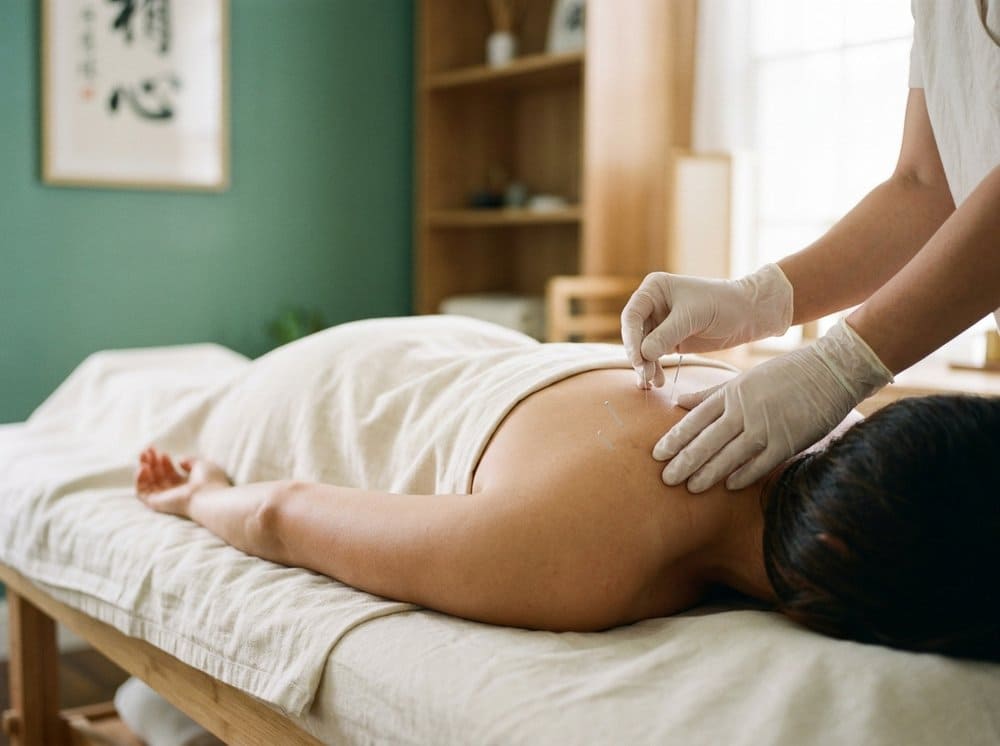
The clinical implication is simple. When we needle a point on the Gall Bladder channel for a chronic knee presentation, we are working on a real anatomical corridor — fascia, nerve, microcirculation — that the ancient physicians mapped observationally without the benefit of histology. The map was accurate before we knew why. That is not mysticism; it is good empirical science, done in a different century with different instruments. Our acupuncture practice is built on this premise rather than on any metaphysical one.
The meridians are not lines drawn on the body by the mind. They are lines the body itself drew, which careful observers noticed and named. The names came in Chinese because the observers were Chinese.
How meridians map to joint pain
For the chronic joint patient, four channels come up constantly in a Makati clinic:
Gall Bladder (GB)
The lateral channel par excellence. It runs down the outside of the thigh, over the lateral knee, down the fibula, and over the outer ankle. Lateral knee pain, ITB-related presentations, lateral hip bursitis — all of these are GB territory. Patients often describe the pain as sharp on the outside of the knee when descending stairs.
Stomach (ST)
The anterior channel, running down the front of the thigh, over the patella, and down the anterior tibia. Patellofemoral pain, quadriceps tightness, the classical "runner's knee" presentation — all ST. When we do tropical Bi-syndrome work in the Manila humidity, ST points take up a disproportionate share of the needling.
Bladder (BL)
The longest channel in the body, running from the inner canthus of the eye over the crown, down the paraspinal muscles in two parallel lines, through the back of the thigh, over the popliteal fossa, down the calf, and out to the fifth toe. Low back pain, sciatica, posterior knee work — BL.
Kidney (KI)
The medial channel, inside of the thigh, through the medial knee, up the inner calf. Medial knee arthritis, inner hip pain, and — in classical theory — the root of many chronic degenerative joint conditions because Kidney governs bone and marrow.
Pulse, tongue, and the meridian reading
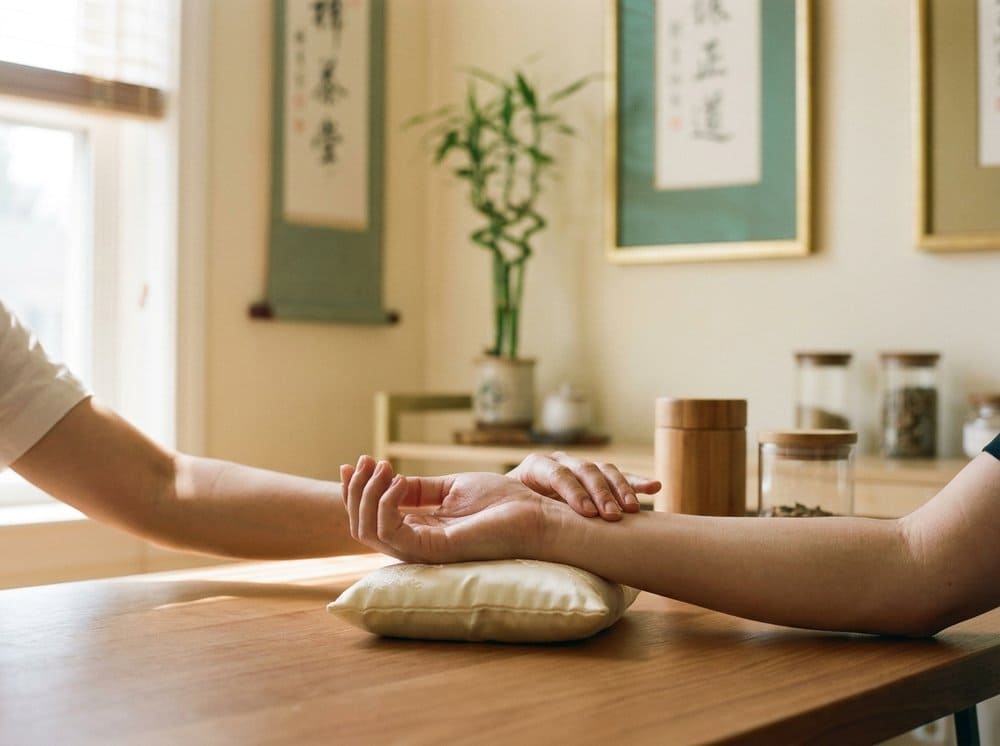
Meridian diagnosis does not happen in isolation. It sits inside a larger clinical reading that begins at the wrist and the tongue. If you are curious about how a physician actually reads those two surfaces — what a slippery pulse feels like, what a red-tipped tongue means — my colleague Liu Hsiu-mei has written an excellent patient-facing guide to pulse and tongue diagnosis that I recommend to every new patient.
Why the map is useful to you
You do not need to memorise the meridians to benefit from acupuncture. But a working sketch of the map helps you understand why your physician is needling a point on your foot for a shoulder problem. The channels connect distant regions. A classical point on the far end of one channel can influence pain at its near end — the principle of distal treatment — and this is not superstition but a well-documented neurogating phenomenon. It is also why integrative TCM work often surprises patients: the logic is not local, it is relational, and the relations were mapped centuries before fascia had a name.
Every chronic pain consultation in our clinic includes, near the start, a minute or two of showing the patient which channels are involved. It is the simplest way to teach, and patients consistently tell me it is what makes the rest of the work make sense. The practical conversation afterwards — how this will shape an integrative plan with an MD or a physiotherapist — is where the map earns its keep.