My grandmother, who came to Manila from Fujian in the 1930s and ran a small herbal stall near Ongpin Street in Binondo, used to say that a Chinese kitchen is already half a pharmacy — the other half being the patience to boil things slowly. Forty years later, I find her words sitting on top of a remarkably consistent body of modern pharmacology. The staples she reached for on arthritic mornings — turmeric, ginger, goji, astragalus, and a clear pork-bone broth — are also, by now, among the most studied anti-inflammatory foods in the world.
This piece is a kitchen-first reading of five of them. It is not a replacement for diagnosis. If you do not yet know your pattern, begin with our note on how TCM reads chronic joint pain differently — the same food that soothes one bi-syndrome can aggravate another.
1. Luyang dilaw — turmeric (jiang huang, 薑黃)
The bright-orange rhizome the Chinese-Filipino aunties call jiang huang and the Tagalog kitchen calls luyang dilaw has been used in both traditions since at least the Ming dynasty. In TCM energetics it is warm and pungent, enters the Liver and Spleen channels, and is classically indicated for blood stasis with cold — the slow, dark, aching joint that hurts worst when pressed and feels better with warmth and movement.
The active compound, curcumin, has been the subject of hundreds of clinical trials in osteoarthritis. The consensus is modest but real: a daily dose, taken with black pepper and a fat (curcumin is fat-soluble and absorbed poorly on its own), produces pain reductions comparable to low-dose NSAIDs with a far better long-term safety profile. Our usual clinic recommendation is a small knob of fresh turmeric simmered for ten minutes in coconut milk with a pinch of black pepper and a sliver of ginger. Drink warm, once daily.
2. Luya — ginger (sheng jiang, 生薑)
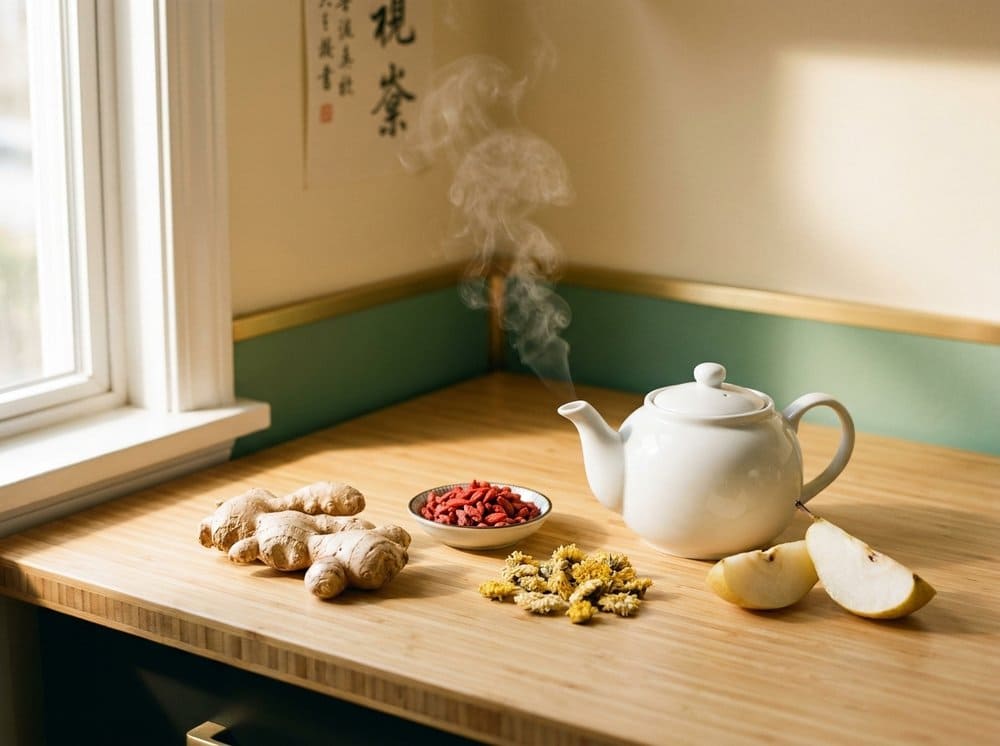
Ginger is the workhorse. Warm, pungent, and moving, it enters the Lung, Spleen, and Stomach channels and disperses cold from the surface. For the patient with damp-cold bi — the stiff morning knee that loosens with a warm shower — fresh ginger is often the first and cheapest intervention.
Three thin slices in a mug of hot water, taken first thing in the morning, is the simplest form. For a stronger dose, simmer a larger piece with brown sugar and a pinch of cinnamon bark (rou gui) for twenty minutes. Avoid ginger if the joint is red, hot, and swollen — that is a damp-heat presentation and ginger will aggravate it. For the wider climatic logic, see our piece on why knees ache before the rain.
3. Gou qi zi — goji (枸杞子)
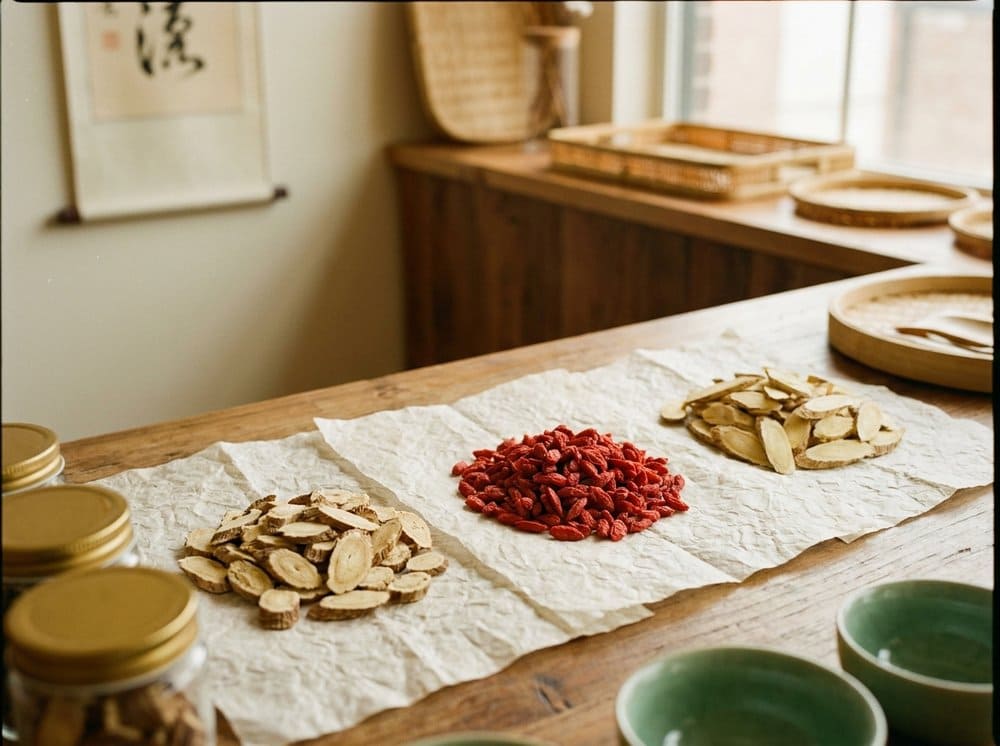
The small red berry my grandmother kept in a squat clay jar beside the stove is one of the few TCM herbs whose role has not shifted in two thousand years. Goji is sweet and neutral, enters the Liver and Kidney channels, and is a nourishing tonic for the yin — the cooling, moistening, structural aspect of the body that, in classical theory, underwrites the health of tendons and the smooth gliding of joints.
In the kitchen, a tablespoon of dried goji added to the rice pot in the last ten minutes of cooking is the easiest vehicle. A second tablespoon steeped in a thermos of warm water, sipped through the afternoon, is the common Taipei office worker's version. Goji is safe with almost every Bi-syndrome pattern and is particularly useful for post-menopausal women with dry, brittle joint presentations.
4. Huang qi — astragalus (黃耆)
Huang qi is the great tonifier of qi and defensive energy in the Chinese herbal canon. A slow-simmered slice in a chicken or pork broth is a classical preparation — it does not taste of much on its own, which is the point. Huang qi is a background support, the herbal equivalent of replacing a weak foundation under a tired house. Patients with chronic joint pain, particularly those who catch every cold in the office and who feel fatigued by three in the afternoon, are often running on depleted wei qi, and huang qi is the standard reply.
"Huang qi does not chase the pain. It strengthens the host so the pain finds nothing to hold on to." — from the clinical notes of my teacher, a fifth-generation physician in Taipei.
A caution: huang qi is too warming during acute flares with heat signs. It is a tonic for quiet phases, not active inflammatory ones. Dosing and combination are best worked out in a formal herbal consultation with a physician who has read your pulse.
5. Pork-bone broth — the sinigang without sampalok
The slow-simmered bone broth is the meeting point of Chinese and Filipino kitchens. Sinigang, stripped of its souring agent (sampalok or calamansi) and simmered for three or four hours instead of forty minutes, becomes something very close to the tang a Cantonese grandmother would make for a convalescent: cloudy-clear, gelatinous, nutrient-dense, and deeply nourishing to the joints.
Use two kilos of pork leg bones or oxtail. Cover with cold water, bring to a slow simmer — never a rolling boil — and skim the scum for the first twenty minutes. Add a generous knob of ginger, two thick slices of huang qi, a small handful of gou qi zi, and three dried shiitake mushrooms. Simmer covered for three to four hours. Salt to taste at the end. Drink a cup warm with the evening meal, three times a week.
The collagen and glycosaminoglycans in the broth are more than kitchen folklore — they are the raw materials the body uses to rebuild articular cartilage and synovial fluid. For a broader exploration of this kitchen-as-medicine philosophy, see our eastern wisdom note on food as the first prescription.
What to keep out of the bowl
The Chinese-Filipino kitchen is forgiving, but three habits quietly erode joint health in our clinical experience.
- Iced drinks with every meal. Cold liquids directly impair spleen function and compound dampness. Room-temperature water or warm tea is the classical replacement.
- Unripe mango with rice at lunch. Excessively sour-cold food on top of a heavy, starchy base is, in TCM terms, a near-perfect recipe for damp stagnation in the middle jiao. Ripe mango is fine in moderation.
- Deep-fried dishes daily. Fried oil generates damp-heat, which worsens red, swollen, hot joint presentations within days. Twice a week is plenty.
How fast the kitchen changes a joint
Kitchen work is slow work. Patients who adopt the full set of recommendations above — daily ginger or turmeric in the morning, goji in rice or tea, a thrice-weekly bone broth, and a considered removal of the three habits listed — typically report a softening of joint stiffness at the four-to-six week mark. Acute flares may still occur; the baseline, however, shifts. That shift is the quiet work of food, and it is often what keeps a patient from needing a tenth round of acupuncture.
If you are already under care and want to work out which of these staples fits your particular pattern, bring a week of your actual meals — photos on your phone are fine — to your next visit. The consultation is, more than anything, a conversation between your kitchen and your pulse.