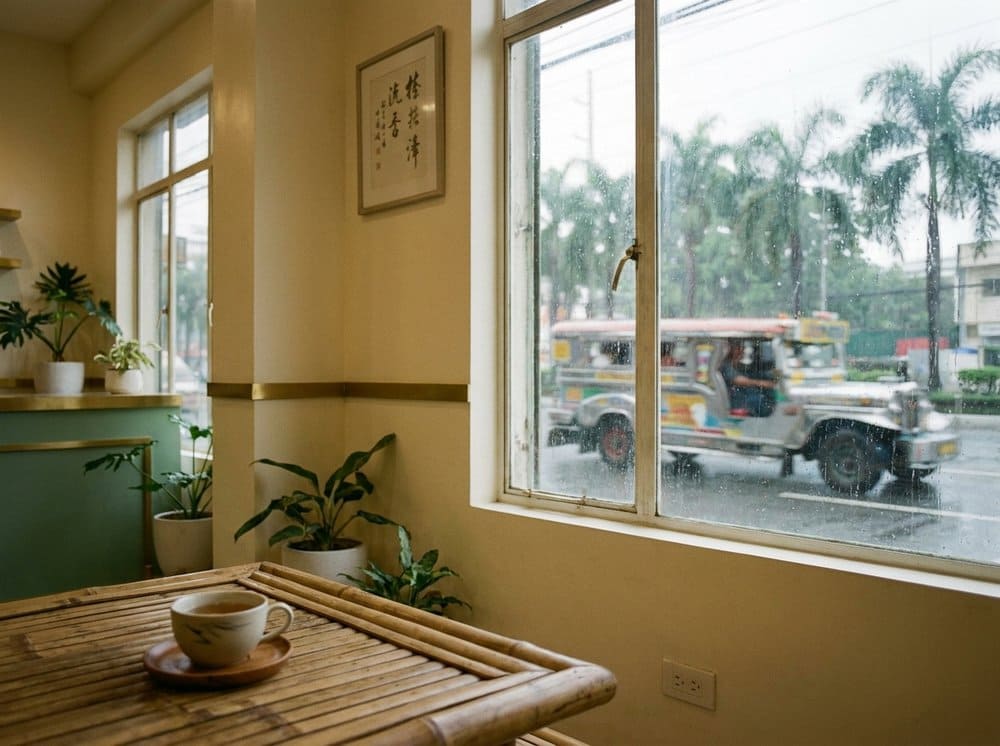
Every clinic in Metro Manila has a version of the same conversation. A patient arrives, sits down, and says, almost apologetically: "I think there is a storm coming. My knee knew first." The apology is for the unscientific phrasing. The observation, however, is almost always correct. Barometric pressure begins to fall roughly eighteen to thirty-six hours before a low-pressure system arrives, and the human joint — particularly an arthritic one — is a surprisingly sensitive instrument for detecting that drop.
This is not folklore. It is measurable physics filtered through measurable physiology. The classical Chinese reading, captured in the Huangdi Neijing two thousand years ago, reads the same phenomenon through the language of wind, cold, and dampness. Both readings point to the same clinical moment.
The physics, briefly
At sea level in fine weather, atmospheric pressure sits near 1013 hPa. When a low-pressure system — a tropical depression, a storm cell, a full-scale typhoon — moves in, that number can fall ten to twenty points over a day. Inside an inflamed joint, the synovial capsule contains fluid at a pressure roughly in equilibrium with the outside air. When external pressure drops, the relative pressure inside the capsule rises. The tissues swell. The nociceptors — pain receptors embedded in the joint lining — become more easily triggered. This mechanism is now documented in several peer-reviewed studies, the best-known of which followed osteoarthritis patients across Europe for eighteen months and found a consistent inverse relationship between barometric pressure and reported pain scores.
A healthy, quiet joint barely registers the change. An arthritic joint — with thickened synovium, reduced cartilage, and resident low-grade inflammation — amplifies it. This is why the knee with a torn meniscus from 2008 is a better barometer than the household one.
The Manila monsoon calendar
The Philippines sits inside the western Pacific typhoon belt. Roughly twenty tropical cyclones enter the Philippine Area of Responsibility each year; eight to ten make landfall. The wet habagat monsoon runs, in broad terms, from June through November. A second, drier amihan wind shift arrives in late December. Our clinical caseload reflects these windows with almost embarrassing precision.
- Late May to early July — pre-habagat pressure instability. The rains have not yet settled, but atmospheric pressure begins its long downward oscillation. Joint complaints rise sharply in this period, particularly among patients who do most of their commuting on foot or by jeepney.
- August and September — peak typhoon season. Direct-hit systems bring dramatic, short-window flares. An indirect pass — a typhoon tracking north over Luzon Strait — can still drop pressure enough over Metro Manila to trigger widespread knee and shoulder flares.
- Late December — the amihan transition. Colder winds from the northeast coincide with a shift in pressure patterns. Older patients, particularly those with post-surgical joints, often have a week of flare-up around this calendar change.
Patients who track these windows in a simple notebook — date, weather, pain score out of ten, notes on sleep and diet — arrive within three months at a personal climate-pain map that is often more useful than any MRI.
The TCM reading: wind, cold, damp in procession
The Huangdi Neijing names three of the six climatic pathogens as principal causes of bi-syndrome: wind (風), cold (寒), and dampness (濕). A pre-storm day in Manila brings all three at once. The wind rises as pressure differentials accelerate. The temperature drops — noticeably, even in a tropical city, by two or three degrees as heavy cloud blocks the sun. Humidity climbs as the air saturates. For a patient with an already-compromised joint, this is a near-laboratory setup for the classical cold-damp bi pattern described in our longer piece on how TCM reads chronic joint pain.
"Wind arrives first and announces the others. Cold lodges in the sinews. Damp fills the joint. Treat the wind early, and the other two find less purchase." — a paraphrase of commentary on Chapter 43 of the Suwen.
What to do on a storm-approaching day
The best treatment for pre-rain flares is preventive — applied before the pressure drop fully lands, not after. When the weather apps show a low-pressure area developing east of Samar and your barometer (or your knee) confirms it, run the following small protocol.
Warm compress on Zusanli (ST-36)
Fill a clean towel with hot water, wring it out, and apply it over the point four finger-widths below the kneecap and one finger-width lateral to the shin bone. Ten minutes on each leg. This point warms and supports the Stomach channel, which in TCM energetics has a central role in clearing damp accumulation from the lower limb.
Warm ginger tea, taken three times across the day
Three thin slices of fresh ginger, steeped in hot water for five minutes, taken morning, noon, and late afternoon. Ginger's warming, dispersing action counteracts the wind-cold-damp trio at its most basic level.
Avoid cold water on the joints
No cold showers, no ice-cold drinks, no swimming in an unheated pool on a storm-approaching evening. Wear long trousers and, if possible, a light wrap or knee sleeve during the commute. Patients often resist this as overcautious — until they have tracked the flare that follows ignoring it.
Gentle movement, not rest
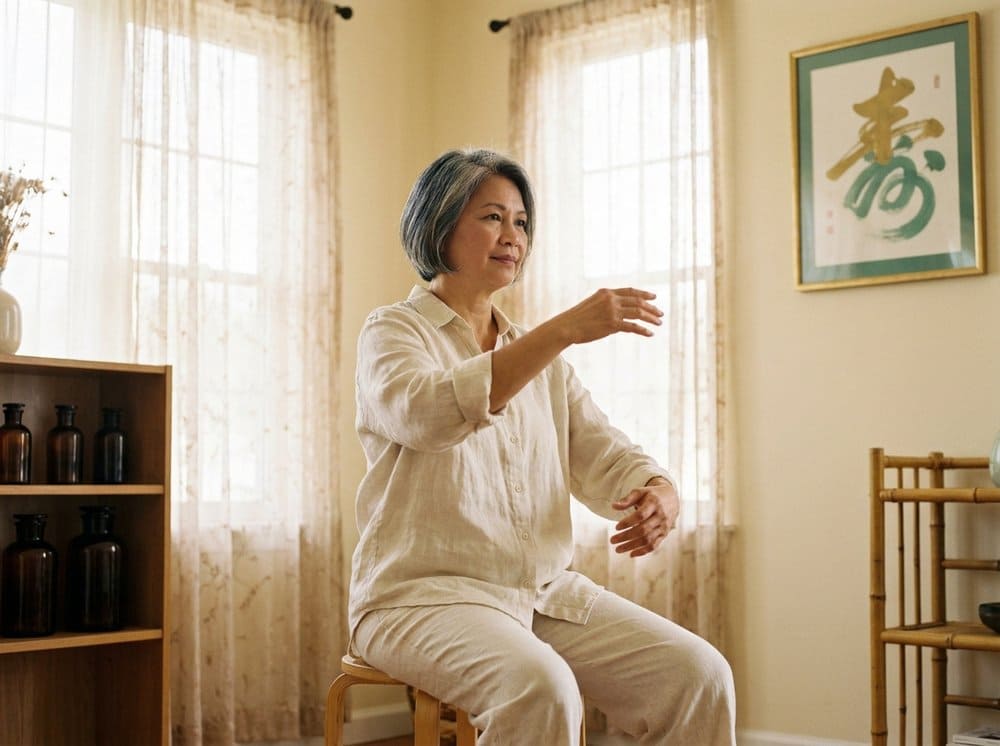
Stagnation worsens cold-damp bi. A twenty-minute indoor walk around the condominium corridor, or a gentle qi gong sequence from our morning habits note, is far better than sitting still through the weather.
When the storm has already landed
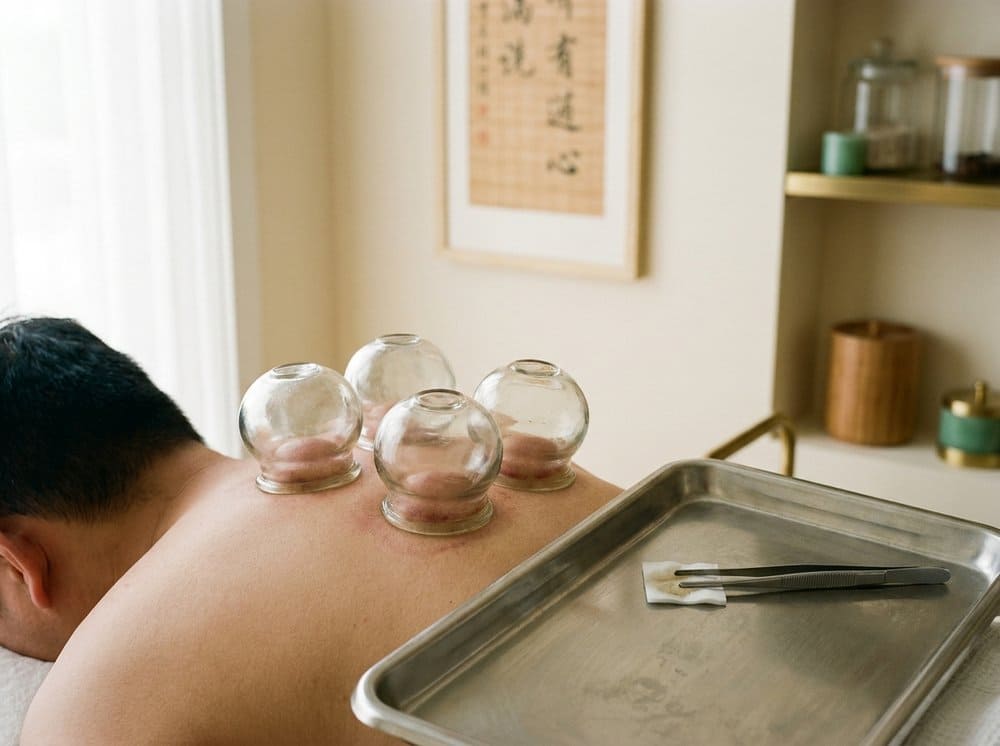
If the flare has set in and the joint is now swollen, heavy, and aching, the two most useful in-clinic interventions are carefully placed acupuncture along the affected meridian and selective cupping (ba guan) to draw out the stagnant fluid. A single session during a flare often reduces pain by a full two or three points on a ten-point scale by the evening.
A longer arc
The goal of seasonal work is not to make an arthritic knee insensitive to weather. That is neither possible nor desirable — the responsiveness of a living joint to its climate is part of how the body keeps itself whole. The goal is to shrink the amplitude of the response. A patient who used to lose two days of normal life per storm and now loses half a morning has made a meaningful clinical gain. That is usually what steady care, over six to twelve months, achieves.
The first step is often the simplest one: keep the notebook. When the pattern of your own joint against your own city becomes visible to you, prevention stops being abstract and starts being obvious. The rain will still come. The next flare, though, will be a little quieter. For a broader classical frame around climate and the body, our eastern wisdom note on seasonal medicine covers the philosophical ground.