Most of our joint-pain patients have already been told, correctly, that the first hour of the day is the most important. What they have not been told is what, precisely, to do in that hour. Generic advice — "stretch a little" — does not survive contact with a stiff sixty-two-year-old knee at five forty-five in the morning. The rituals below are what we actually teach at the clinic. Each takes about two minutes. Five together run to roughly ten. None require equipment, space, or a yoga mat you do not want to buy.
These habits sit alongside the deeper pattern work described in our companion piece on how TCM reads chronic joint pain. Think of them as the daily maintenance that keeps treatment results stable between clinic visits.
1. Meridian tapping — the wake-up sequence (two minutes)
Sit upright on the edge of the bed, feet flat on the floor. With loose, cupped palms, tap briskly but gently down the outside of each arm from shoulder to wrist — this follows the Large Intestine and Triple Burner channels. Then tap up the inside of the arm from wrist to armpit — Lung and Pericardium. Repeat three times. Move to the legs: tap down the outside of the thigh and calf, then up the inside. Finish with a dozen light taps around the lower back, over the kidney region.
The goal is not force. The goal is sensation — a warm, awake feeling in the skin and muscle. This is the simplest form of channel-opening qi gong, and it reliably reduces the "I cannot feel my feet yet" complaint older patients report.
2. The standing qi gong stretch: Eight Strands, abbreviated (two minutes)
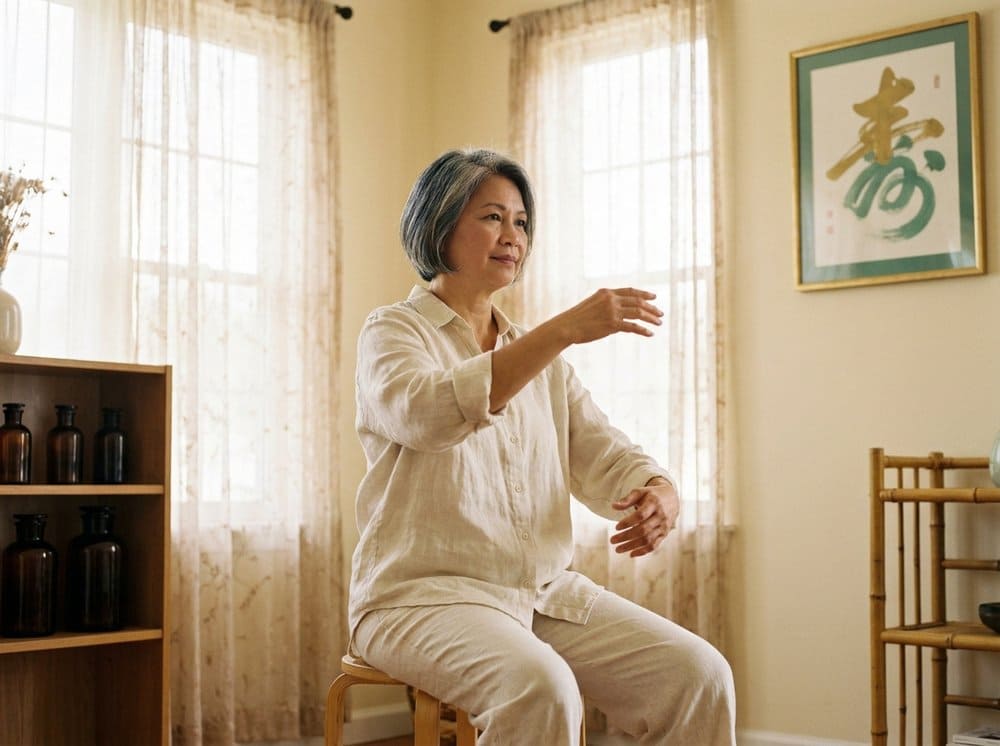
Stand with feet shoulder-width apart, knees soft. Raise both arms slowly overhead, palms up as if lifting a low ceiling. Pause. Exhale and bring the hands down in a wide arc past the sides of the body. This is a compressed version of the opening movement of Ba Duan Jin — the Eight Pieces of Brocade — a qi gong form traceable to the Song dynasty and still taught in hospital rehab wards in Beijing and Taipei. Repeat eight times at a breath-paced tempo. Follow with eight slow waist rotations, clockwise and counter-clockwise.
The point is not cardiovascular work. It is to return length to a spine that has been folded into a mattress for seven hours and to move synovial fluid through joints that have been idle. If this form interests you, it deserves the fuller treatment given in our notes on qi gong as a clinical adjunct.
3. Ankle circles and toe fans (two minutes)
Sit on the bed or a chair. Lift the right foot off the floor. Draw ten slow circles with the toes — five in each direction. Then fan the toes as wide as you can, hold for a count of three, and curl them under tightly. Repeat that fan-and-curl ten times. Switch feet.
This small ritual does two things. It lubricates the ankle, a joint almost every Filipino over fifty has quietly injured on uneven pavement at some point. It also activates the Spleen and Liver channels, both of which begin on the medial foot and are closely associated with dampness clearance — the single most common aggravator of morning stiffness in this climate.
4. Self-tuina on Hegu and Zusanli (two minutes)
Two points, held with thumb pressure, for one minute each. Take this slowly — the goal is a dull, radiating ache called de qi, not a sharp pain.
- Hegu (LI-4) — on the back of the hand, in the web between the thumb and index finger, at the highest point of the muscle when the thumb is adducted against the index finger. Use the opposite thumb, press firmly, and hold for sixty seconds. Hegu is the premier point for moving qi through the upper body and is classically contraindicated in pregnancy.
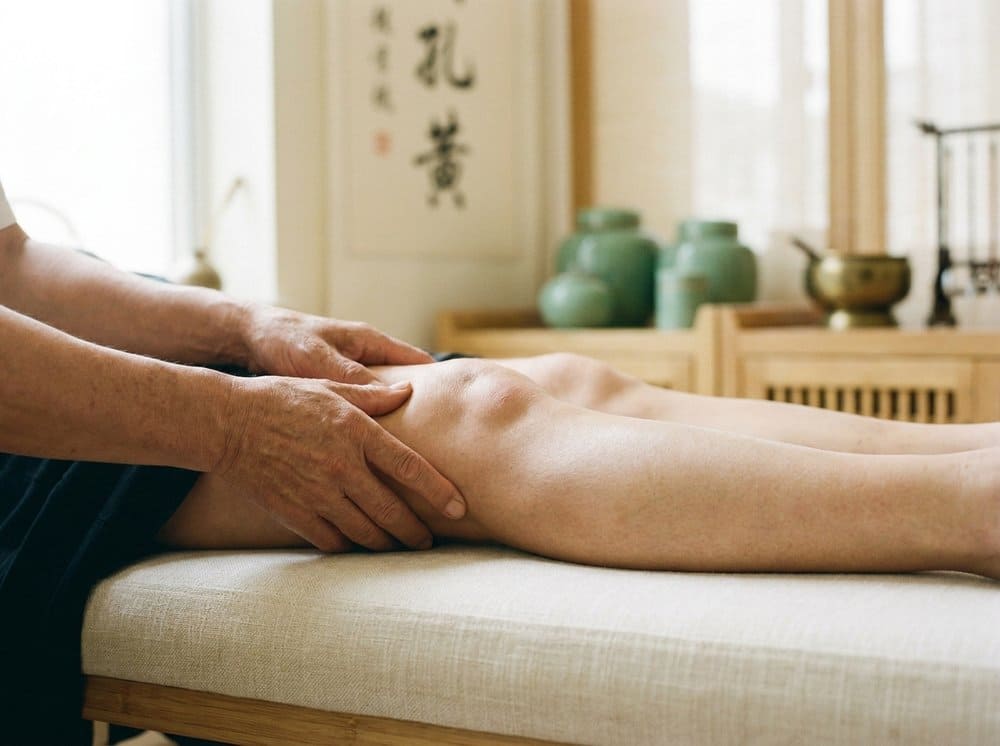
- Zusanli (ST-36) — four finger-widths below the kneecap, one finger-width lateral to the shin bone. Use the thumb or the knuckle of the index finger. Hold for sixty seconds on each leg. Zusanli is the longevity point of Chinese medicine; Japanese folk practice holds that daily moxibustion here adds years to a life, and while we make no such promises, we do see reliable improvements in morning leg stiffness when patients treat this point faithfully.
If thumb pressure is uncomfortable — arthritic hands often cannot produce sustained force — our tuina service page describes how to use a smooth wooden tool or the rounded end of a pen instead.
5. Warm ginger-goji tea (two minutes of brewing, one minute of drinking)
Boil a kettle. Into a mug place three thin slices of fresh ginger (luya), a scant tablespoon of dried goji berries (gou qi zi), and, if you have it, a small piece of red date (hong zao) cut open. Pour the boiling water over. Cover and steep for three minutes. Drink warm, slowly, before any cold water or cold coffee reaches the stomach.
"The first liquid of the day becomes the climate of the whole morning. Give the spleen warmth and it will thank you by noon." — a line from our senior herbalist's consultation notes.
Ginger is warming and drying — the two qualities that counter damp-cold bi most directly. Goji nourishes liver blood, which the classical texts link to the flexibility of tendons. Red date tonifies spleen qi, the body's main bulwark against dampness. The tea is simple, inexpensive, and in our experience the single dietary change most likely to be sustained past the first week.
When to expect results, and when to come in
Patients who perform these five rituals daily, without missing more than one day a week, report a measurable change in morning stiffness at the three-week mark. By eight weeks, the change is usually stable enough that a missed day is noticed as a small regression — a useful feedback loop. If after eight weeks there is no improvement, the issue is almost never effort. It is almost always pattern: what we are calling "morning stiffness" is in fact a different syndrome requiring a different plan. That is the moment to come in for a seventy-five-minute assessment and pulse-tongue reading.
A final note on consistency
Ten minutes a day is not much. It is also, for almost every patient we have worked with in fifteen years of practice, the hardest ten minutes to protect. We suggest linking the sequence to something you already do — the first cup of anything, the morning shower, the arrival of the newspaper. When the ritual is attached to a fixed anchor in the day, it stops being willpower and starts being habit. That is when the joint begins, quietly, to change.