The cervical spine is, biomechanically, one of the least forgiving structures in the body. Seven small vertebrae support a head weighing roughly five kilograms in neutral position. Tilt that head forward by fifteen degrees and the effective load on the neck doubles. Tilt it forward by forty-five degrees — the angle of almost every smartphone screen held in the lap — and the effective load reaches twenty-two kilograms. We were not built for that kind of sustained loading.
In my clinical work, cervical complaints in desk-bound patients over fifty follow three recurring postural causes. Fix those three, layer in two small daily self-care rituals, and most neck and upper-back pain in this population becomes a manageable background condition rather than a progressive one.
1. The phone angle
Almost every patient who arrives with chronic upper-back stiffness and occasional cervicogenic headaches owns a smartphone and holds it low. The solution is almost embarrassingly simple: raise the phone, do not lower the head. Bring the screen up to the height where your eyes meet it with only a ten-degree downward gaze, not forty-five. The simplest implementation is to rest your elbow on a desk, a chair arm, or your opposite forearm and hold the phone close to eye level.
For long reading or scrolling — thirty minutes or more — put the phone in a small stand and keep the hands free. The posture that matters is the one you hold for the longest period. A single session of good phone posture a day is worth less than a whole day of slightly-better phone posture.
2. The desk
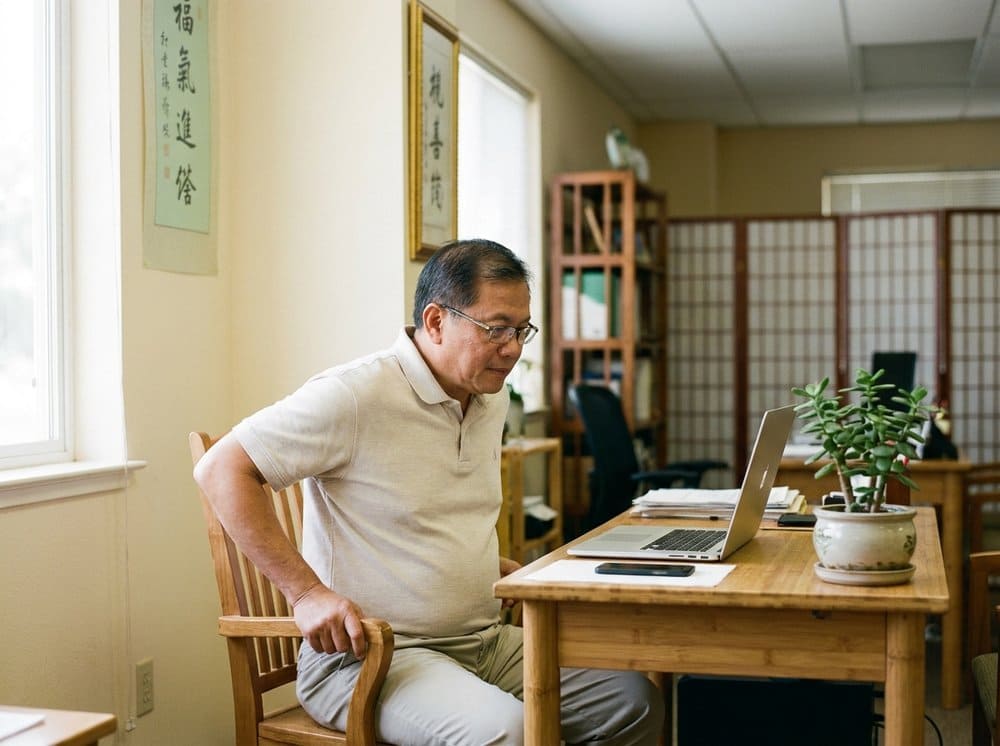
The ergonomic standard is well-established but, in my experience, widely ignored in Makati office towers. The screen should sit so the top of the display is at or slightly below eye level. The elbows should rest at roughly ninety degrees on the desk, shoulders down, not hunched. The feet should rest flat on the floor or on a small footrest.
Two common Manila setups break this arrangement. The first is the laptop-on-a-low-desk pattern — inherited from working from home during the pandemic, now entrenched. The second is the tall-desk-short-chair pattern, common in shared serviced offices where the furniture was chosen for an average Western European body. Both drive a forward head posture and silently compress the cervical spine throughout the workday.
The cheapest fix is a stack of books under the laptop, a separate keyboard, and a chair cushion that brings your elbow to desk height. Budget this before a new ergonomic chair. For the daily maintenance work that keeps a better-arranged spine flexible, see our companion piece on morning stiffness habits.
3. The jeepney seat
Public transport posture deserves its own paragraph. A typical jeepney ride involves facing perpendicular to the direction of travel, with the head turned forty-five to ninety degrees to see out, hold a conversation, or watch the driver for the stop signal. If the ride lasts twenty minutes, the cervical spine has been held in a rotated, slightly flexed position for twenty minutes — easily the most damaging single posture of a Manila workday for many patients.
Two simple adjustments help. First, sit as close to the end of the bench as possible, so you can keep your head closer to neutral with minimal rotation. Second, if the commute is longer than thirty minutes, consider a bus or a ride-hailing service where you can face forward. For patients with existing cervical degeneration, this change alone has reduced pain scores more than any in-clinic treatment I have offered them.
Two points to know
Two acupuncture points belong in the routine of every desk worker over fifty. Both can be self-massaged in under a minute. Both are especially useful at the end of a long computer-bound day.
Shou San Li (LI-10)
Find the crease of the elbow when the arm is bent. Measure down from the crease toward the hand by the width of three of your own fingers, along the outer edge of the forearm. Press with the opposite thumb. You should feel a dull, satisfying ache that radiates toward the hand. Hold for thirty to sixty seconds on each arm. Shou San Li belongs to the Large Intestine channel, which runs from the index finger through the shoulder and neck to the face. Releasing tension here often reduces referred stiffness in the upper trapezius and neck.
Feng Chi (GB-20)
Find the base of the skull. Trace along it laterally until your fingers fall into two small hollows on either side of the spine, roughly in line with the earlobes. Press upward and inward — the sensation should be firm but not sharp. Hold for thirty seconds. Feng Chi — literally "Wind Pool" — is one of the most important points in the entire canon for headache, neck stiffness, and the classical pattern of wind invading the upper body. It is the single best self-care point I teach for the Manila desk worker.
"Feng Chi clears the wind that has lodged at the back of the skull after a day of bad posture. One minute, twice a day, beats a massage chair you never use." — clinical note to a patient.
A short manual-therapy detour
Self-care points are powerful, but they have limits. When tension has organised into chronic trigger points in the upper trapezius and levator scapulae — the two muscles that connect neck to shoulder blade — a skilled manual release is usually faster than weeks of self-work. A forty-five minute tuina session focused on the upper back and cervical region reliably opens these restrictions. Patients often describe the effect as "breathing properly for the first time in a year." For those who want the more systematic option, acupuncture along the Bladder and Gall Bladder channels delivers the deepest relief.
A longer-term view
Cervical degeneration is, for most of us, inevitable with time. What is not inevitable is the rate. A fifty-year-old who implements the three postural corrections above, performs the two-point self-massage daily, and comes in for periodic manual work will, in my experience, hold stable cervical function into their seventies. A fifty-year-old who ignores all of it tends to arrive in the clinic at sixty with structural changes that are much harder to reverse.
The difference, compounded over twenty years, is not about heroic effort. It is about two or three small daily decisions. The phone goes up. The laptop goes on a book. The jeepney seat changes. That is often the whole story. If you want to go further, our honest comparison of acupuncture and physiotherapy lays out how to sequence professional care alongside the daily work described here.